ChargePoint debuts world's fastest standalone charger
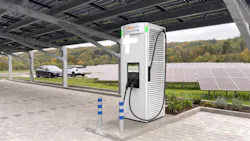
ChargePoint introduced its Express Solo, a standalone DC fast charger capable of delivering up to 600kW to a single vehicle or distributing that power across multiple EVs. The system can charge two vehicles simultaneously and scale up to four with an additional dispenser, allocating power dynamically per port. This flexibility allows fleets and site operators to maximize throughput without oversizing infrastructure.
The charger is built on ChargePoint’s new Express architecture, designed to address common barriers to DC fast charging deployment, including grid limitations, cost, and space constraints. With roughly 40% higher power density than typical systems, Express Solo fits into tighter locations such as urban depots or constrained service areas. It also supports both CCS and NACS connectors through an integrated port system, simplifying compatibility across mixed EV fleets.
“The Express DC fast charging architecture delivers differentiation. Not just by higher output, but by how economically, efficiently, and flexibly that power is delivered. Express Solo combines unmatched power density, direct DC power input capabilities for solar integration and battery storage, and a modular architecture that scales with minimal cost and complexity. Collectively this redefines DC fast charging from a fixed asset into a future-ready energy platform,” said Rick Wilmer, CEO at ChargePoint. “For those with plans for expansion, Express Solo enables scalable configurations for any charging scenario, futureproofing a station owner’s investment by giving drivers an ideal fast charging experience today while offering flexibility for the EVs of tomorrow.”
Developed in collaboration with Eaton, the system integrates with on-site energy resources such as solar and battery storage and supports bidirectional charging. This allows fleets to better manage energy demand, potentially offset peak utility costs, and improve resilience. The modular design also enables phased expansion, reducing upfront capital investment and simplifying future scaling.