How wheel-end monitoring puts the brakes on thermal events

Wheel ends are complicated systems and are among the highest friction points on any tractor-trailer, so trucking fleets hear a lot about thermal events at both the wheel and tire. These events are expensive in terms of extra maintenance and downtime, and can cause great harm to equipment, cargo, and even people.
The good news is that in the heavy-duty space, several manufacturers have come to market with wheel-end monitoring technologies—connected via onboard digital hubs to the cloud—that help head off incidents, avoid costly downtime, and identify maintenance errors that can cause wheel- and tire-related problems and failures.
At their most basic level, wheel-end monitoring technologies are “another set of eyes in the maintenance arena to catch things that are [preventable],” said Bryan Lewis, an ASE master truck technician and former instructor who retired from wrench-turning five years ago but now works as a consultant. “We have to up our preventive maintenance game. The more eyes and ears you have on that vehicle, the better, to catch something possibly catastrophic.”
Safety, money, and equipment security motivate fleets to invest in any number of wheel-end monitoring systems. There are several wheel-end monitoring units on the market and others that exist as part of tire-pressure monitoring systems (TPMS). They all can provide data to the fleets that could catch a wheel-end issue before it impacts uptime and safety.
Stop your ignition
Rubber compounds begin to break down when tire temperatures exceed 250 degrees F, warned Phil Arnold, a former product engineer with Michelin North America, at the 2018 American Trucking Associations’ Technology and Maintenance Council Fall Meeting. That’s when a blowout might occur that results from the deterioration of a tire.
The most extreme thermal event—fire—can begin when rubber reaches temperatures of 500 to 550 degrees F and flammable vapors are emitted from the tire. If an ignition source is present, the tire rubber will start burning at 650 to 700 degrees F. Spontaneous combustion won’t occur until 850 to 900 degrees F. The normal operating temperature range for tires is between 100 and 150 degrees F.
“Tires contain a great deal of potential energy,” Arnold explained. “They are like high-grade coal when they start to burn, and they are very difficult to extinguish.”
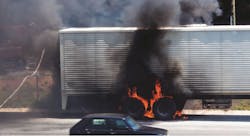
When a tire comes apart while driving, it’s usually the result of underinflation, Arnold added. Heat generated within the sidewalls as the tire flexes weakens the steel belts in the casing while softening the rubber to the point it eventually breaks down and the tire blows apart.
With tire fires, the heat source is the wheel end. Heat travels through the metal of the hub and through the wheel, where it meets the tire bead. Since the bead is built differently from the upper sidewall, the rubber there gets hotter and hotter until it begins burning, rather than exploding as the casing might because of underinflation.
The source of that heat is friction from either a deteriorating wheel bearing or a dragging brake. In the bearing’s case, failure usually stems from lack of lubrication. Brakes can drag due to multiple causes.
What do these “connected” wheel-end technologies monitor to help avoid the most extreme or the most minor maintenance problems? Generally, anything that causes excess heating and vibration in the wheel system—anything that could cause a thermal event—even in the tire itself.
A typical wheel-end system comprises a seal, an inboard and outboard tapered bearing, and a hubcap. Additional wheel-end components include a spindle nut and wheel nuts, and some wheel-end systems may also contain a spacer that is meant to provide preset torquing.
Each of these components plays a vital role in protecting the wheel end as well as the operator.
Where wheel-end monitoring comes into play is when the trailer or tractor is in motion—detecting and flagging problems before or after the time when wheel ends are inspected to ensure safety and maximize performance.
Scheduled inspections help determine if a wheel-end repair is necessary, but monitoring systems give fleets and technicians clues about what might be amiss even before the trailer or tractor makes it to the shop for examination.
Sensing danger
Monitoring systems are all about the data, according to Paul Washicko, VP and general manager of ConMet’s digital business unit. He detailed at length the PreSet Plus SmartHub, which is ConMet’s connected wheel health monitoring system integrated into a hub assembly that “generates actionable intelligence on wheel-end health,” according to the manufacturer.
Washicko said the low-power electronic sensor of the PreSet Plus SmartHub installs to the barrel of the wheel hub and transmits data to a “gateway” (installed on the bogey underneath a trailer or under the dash on a tractor), sending data from that “vehicle area network” to the SmartHub’s interface dashboard or to common trucking industry telematics products such as Geotab, Lytx, Samsara, Solera (Omnitracs), and others about wheel end, brake, bearing, and tire health.
“We have all this data, and we understand when a component gets to a temperature where it’s failing,” Washicko said. “We’ve taken advantage of the low-power electronics where we can actually put this out in the real world with fleets, monitoring temperature and vibration to see the health of the wheel end. We can separate out the frequencies of bearings and tires.
“It’s interesting how we’re able to separate out those tire issues from bearing problems,” Washicko continued. “We’ve been able to pick up a bearing failure so early that a mechanic is not able to detect it.” He also said ConMet’s system picks up on flat spots in tires, misalignments, and even objects lodged in tires based on their different frequencies detected by the sensor.
Alerts from the SmartHub most often pertain to tires, steer tires especially, he explained. ConMet partners with more than 60 fleets to use the SmartHub system, Washicko said.
“We find out remarkable things about this system every day,” he said. “Fleets don’t expect the alerts. We’re giving them visibility that we’ve never had before. We’ve picked up three different hub issues that would have been catastrophic, two were from damaged seals in the bearings. They had been in periodic maintenance [in fleet shops] and hadn’t been detected.”
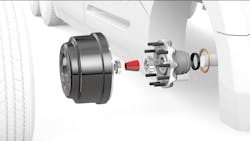
The TraX from SKF looks different but functions very similarly to the ConMet PreSet Plus SmartHub. The assembly mounts to any wheel of a heavy-duty vehicle and wirelessly transmits data to an onboard transponder. The wheel-bearing vibration and temperature data are then relayed to a maintenance location or the driver’s smartphone app, which alerts fleet technicians and the driver long before a failure in the wheel end or tire occurs. If a thermal event is detected, the truck’s driver is notified immediately to pull over to avoid a failure that could be catastrophic.
TraX also can integrate with Drōv Technologies’ AirBoxOne Smart Trailer solution, which includes a telematics and pneumatics ECU and on-vehicle computer system that can read multiple sensors—from wireless to wired sensors. It has Bluetooth, CAN, Ethernet, Wi-Fi, cellular connectivity, seven radios, and GPS capabilities.
“AirBoxOne does a lot of connecting to safety points on the vehicle,” said Pete Jankowski, CTO of Drōv Technologies.
The AirBoxOne sits on the bogey near the axles, tires, and wheel. It is connected to the air system as well, which allows it to regulate tire pressure through automated inflation and deflation according to determined parameters set by either the fleet or in conjunction with Drōv and the tire OEMs’ recommended psi.
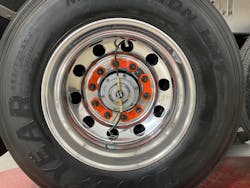
“It also has the ability to read the sensors at the wheel end, TPMS sensors for the tire pressures for each individual tire and the temperature of the air inside the tire,” Jankowski explained.
The integrated solution includes three monitoring points at the wheel end. These include the temperature sensor and pressure sensor for the tire; the TraX system for the bearings and the hub health, and to make sure there’s no vibration or wheel wobble; and a sensor to detect heat near the brakes.
To further differentiate problems from causes, the AirBoxOne also monitors the air pressure of the braking system, understanding when brakes are being applied or if a brake is dragging.
“That can be a problem with a wheel fire or fuel economy, too,” Jankowski said of dragging brakes. “If you’re dragging a brake just a little bit, it’s a problem. So, we are monitoring both the service and parking brake pressure lines.”
The AirBoxOne has those sensors on it to preemptively determine thermal events that could occur at the wheel end; notifications of any arising issues are delivered to both the fleet and the driver immediately.
Drōv also has an iOS and Android application that the driver can use to see the health of the vehicle. This includes the alerting system from any of the wheel ends. The fleet itself is able to leverage an interface from the office to monitor the health across all assets.
“If they have an alert, they’ll see it immediately and then can schedule maintenance or get the trailer off the road if it’s an emergency alert,” Jankowski stated. “The idea is to get information to the fleet and the driver well before an event happens. It isn’t that you get an alert, and the wheel end is already in trouble; it’s kind of preemptive maintenance, so that you have time to get the vehicle off the road so that you don’t have an on-road event.”
The system’s notification alerts are tiered as ‘Warning,’ ‘Critical,’ and ‘Emergency.’ Warning and Critical alerts allow plenty of time to get the vehicle off the road or even to the nearest service center, whereas Emergency alerts are intended to notify the driver to get the vehicle off the road immediately.
Hendrickson’s trailer wheel-end monitoring product—WATCHMAN, powered by the Sensata Vehicle Area Network—pays attention to tires and the brakes of a wheel assembly, explained Steve Hampson, director of electronic controls for the aftermarket manufacturer.
As for WATCHMAN, it relays trailer tire pressure and wheel-end temperature data to a fleet via the product’s trailer telematics system, according to a Hendrickson fact sheet.
WATCHMAN integrates with TIREMAXX, which is Hendrickson’s tire-pressure monitoring system that helps minimize tire wear and maximize fuel economy by managing trailer tire pressures. TIREMAXX has tire-inflating and pressure-relieving, and equalizing capabilities, according to the fact sheet. The manufacturer worked with the Society of Automotive Engineers on industry standards for the communication of data and fault codes for trailer wheel-end information.
“This common platform allows Hendrickson’s WATCHMAN wheel-end sensor to be used by OEMs to provide crucial trailer data to their customers,” explained Omar Fernandez, director of marketing at Hendrickson Trailer Commercial Vehicle Systems.
Hampson added additional perspective on thermal events, what causes these events, and what WATCHMAN does for fleet maintenance managers and drivers.
“Brakes are the heat generator,” he said, adding that numerous wheel-end components generate excess temperatures, hubs and bearings among them. “By the very nature of it, the wheel end gets hot by use of brakes. There are normal operations of brakes, controlled, [but] it’s when it exceeds those thresholds.
“It’s about wheel-end health,” Hampson continued. “That can equate to a lot of things. It’s predominantly focused on the tire, looking at the pressure in the tire system, and making sure that it’s level.”
WATCHMAN also warns drivers if they are navigating the road with deflated tires.
“That’s what leads, in some cases, to what they call ‘thermal events,’” Hampson noted. “You’re trying to prevent that thermal event from occurring. We also feel the WATCHMAN product [will identify] slow leaks. Small leaks become bigger leaks, which become even bigger leaks. The inflation system is keeping up with it, but it’s something you should have looked at soon. Address thermal events before they happen.”
WATCHMAN has temperature sensors mounted in the hubcap at the wheel end. “We do get indications if that area starts heating up beyond normal operation,” Hampson said. “Another indicator of problems.”
Early warnings of low tire pressure, leakage, and/or elevated temperatures can help minimize the cost of repairs and maintenance of crucial wheel-end components. WATCHMAN’s hubcap-mounted, battery-powered wheel-end sensors transmit wireless signals to the gateway module, collecting the data and acting as the trailer’s communication hub. The information is then transmitted from the gateway module to the trailer telematics device for transmission to the fleet’s back office.
ConMet, SKF, Hendrickson, and Drōv Technologies are all working with telematics providers to integrate data from their systems into telematics solutions to provide timely and actionable data presentation for enhanced fleet efficiency and uptime.
Data driven maintenance decisions
The master tech Lewis said wheel-end monitoring technology data can be used to ease drivability complaints, such as “the shakes and shimmies.”
Vibration detectors, for instance, will point drivers and maintenance providers to “which wheel is potentially creating this problem,” he added.
“I’m an advocate for telematics and data,” Lewis continued. The technology, however, “doesn’t replace the basics,” he said. “We still have to install the wheel seal properly, adjust the wheel bearing properly, and so forth. I can’t echo enough the basics, but this technology is another set of eyes. It’s just another tool for the toolbox.”
With monitoring systems in place, fleets have the opportunity to learn from and leverage the data generated off their assets in order to execute more efficient operations.
“Once you start correlating all of the data, particularly around the wheel end, fleets are going to better understand how those different components are performing versus other components or other manufacturers,” Drōv CEO Lisa Mullen said. “This gives fleets a real insight into spec’ing their trailers in different ways or running different components, maybe by area, maybe by type of asset.”
As the AirBoxOne monitors and records more than just wheel-end related information, it also captures insights into fleet operations and can reveal granular nuances that can lead to higher efficiency and asset life.
“That’s eventually where you really want to get to, because we are recording the GPS location of the vehicle, the weight of the vehicle, how much load is on it, [et cetera],” Drōv’s Jankowski said. “When you start correlating those type of things—how fast the vehicle is going, what road it’s on, if the roads are rough—eventually, a lot of this data is going to be for learning insights into the stuff that we don’t know yet. Things like on this road with this load it seems that we’re heating up our bearings and the wheel ends are running hotter than normal. So specifically, you could start looking at heat reduction.”
Furthermore, Jankowski explained how monitoring technologies can point maintenance personnel in the exact direction of the root cause for performance issues. “If you start seeing events on a specific wheel end, it may be something like the alignment is off on the trailer,” he said. “The AirBoxOne can help the maintenance people identify specifically where there is a problem instead of the driver coming back and saying the trailer seems to be pulling to the right a little bit. With the AirBox One, they can see the data is showing that one of the wheels is getting hot and it may be dragging a brake. They can get to a specific point of looking exactly where it is at without having to look at the whole trailer and figuring out what the problem is.”
Another benefit of wheel-end monitoring technology is the real-time insight into asset lifespan.
“You don’t bring anything to a failure if you have monitoring on those systems,” Jankowski said. “If you bring it to failure, you have to replace a lot. If you have to replace one little component, it’s a lot easier to do.”
Monitoring technologies do more than record data; they can provide the opportunity for fleets to shift from a reactionary to preemptive mindset in asset management and maintenance.
“It changes the mindset of the fleet away from ‘It’s been X many years or X many miles, it’s time to do a change out.’ Now, with solutions like ours and like SKF’s, you have data to know if it is in need of replacement or repair,” Mullen concluded. “And that’s what I think is exciting for fleets is that now they have data-driven decisions instead of just time- or mileage-based decisions.”
Technology is the key to addressing wheel-end and tire problems before they become failures or emergencies. Monitoring the tire and wheel area of trailers and tractors has come a long way in the last 10 to 15 years. Using that technology can reduce downtime in the shop and help avoid expensive repairs for fleets by catching problems early.
One final thing to note is that whatever the wheel-end monitoring solution a fleet chooses, they should factor in training for drivers and technicians to help them understand how the technology should operate and be maintained. With all those parts in place, the industry will finally reach a point where thermal events are no longer a hot topic.
Burning money
- Roadside repairs: $1,150 per event.
- Unplanned maintenance: $3,750, or four times the cost of each planned maintenance event.
- Catastrophic thermal events: More than $400,000 per event.
- Catastrophic wheel-offs: Up to—or more than—$1.5 million per event, which can include significant trailer and cargo damage and even fatalities.
About the Author
 Tyler Fussner
Tyler Fussner
Associate Editor | Fleet Maintenance
Tyler Fussner is Managing Editor - Community Manager at Supply Chain Connect, part of the Design & Engineering Group at Endeavor Business Media.
Previously, Fussner served as the Associate Editor for Fleet Maintenance magazine. As part of Endeavor's Commercial Vehicle Group, his work has been published in FleetOwner magazine, as well as Bulk Transporter, Refrigerated Transporter, and Trailer-Body Builders.
Fussner's May 2022 print feature 'The dawn of hydrogen trucks' was named the best single technology article in B2B by the judges of the 2022 Folio: Eddie and Ozzie Awards. Fussner was also awarded Silver in the Technical Article category for the Trade Association Business Publications International (TABPI) 2021 Tabbie Awards.
Fussner previously served as Assistant Editor for Endeavor's Transportation Group on the PTEN, Professional Distributor, and VehicleServicePros.com brands.
Fussner studied professional writing and publishing at the University of Wisconsin-Whitewater. He has experience in shop operations, is a Michelin Certified Tire Technician, and a Michelin Certified Tire Salesperson.